







SMB leaders are no longer evaluating IT outsourcing as a simple cost comparison. They are weighing cybersecurity pressure, cyber liability insurance requirements, support backlogs, Microsoft 365 administration, vendor coordination, and whether Accounting can forecast technology spend without surprises.
Industry analysts predict that over 60% of enterprises will outsource critical IT functions to MSPs in 2025, making the decision operational rather than theoretical. The benefits of IT outsourcing should be measured through uptime, ticket resolution, security controls, invoice predictability, and internal capacity.
From our perspective, outsourcing works best as a managed, security-centered operating model, not a menu of disconnected services.
Our CFO, Turino Fuad, notes: "Outsourcing works when leaders can see who owns the work, how risk is controlled, and how technology spending supports the business plan."
Build An IT Outsourcing Model That Supports Your Business
Improve support accountability, strengthen cybersecurity, and gain predictable IT planning that fits your workflows, approvals, vendors, and growth priorities.
Benefits Of IT Outsourcing For Operational Maturity
Outsourcing should improve the daily work of the business: approvals, user support, endpoint control, vendor coordination, and budget planning. The market is moving that way, with average IT outsourcing spend projected to reach USD 156.92 per employee in 2025 as leaders use outside expertise to support scale and efficiency.
- Predictable IT spend: Flat-rate pricing gives Accounting a stable monthly number instead of surprise invoices after a firewall issue, laptop refresh, or support spike.
- Faster support routing: AI-assisted triage routes tickets quickly, while scheduling tools let users choose a service time that fits their workday. That reduces phone tag and stalled work.
- Security built in: Cybersecurity belongs inside managed IT from the beginning, not after an audit request or insurance renewal question.
- Specialist access: Network, cloud, VoIP, and cybersecurity expertise should be tied to ITIL-aligned workflows, documented outcomes, and clear escalation paths.
Advantages Of Outsourcing IT Services When Internal Teams Are Stretched
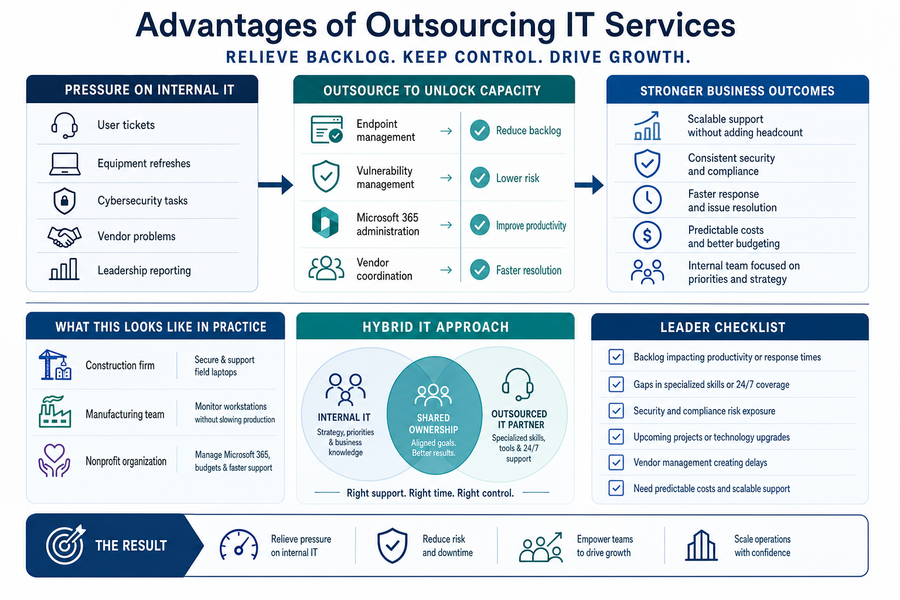
Internal IT leaders often balance user tickets, equipment refreshes, cybersecurity tasks, vendor issues, and leadership reporting. The advantages of outsourcing IT services become clearest when outsourcing reduces the backlog without removing the internal team's knowledge of the business, and 29% of small businesses outsource IT because they lack in-house expertise for growing technology demands.
A construction firm may need field laptops secured and supported across job sites while its internal IT lead manages ERP access. A manufacturing team may need shared workstations monitored without slowing production. A nonprofit may need Microsoft 365 administration, grant-driven budget controls, and faster support without adding another full-time role.
Endpoint management, vulnerability management, Microsoft 365 administration, and vendor coordination usually create the fastest relief. Our Hybrid IT approach supports internal teams with cybersecurity, monitoring, upgrade projects, and complex troubleshooting while keeping decisions grounded in business priorities.
Benefits Of Outsourcing IT Services For Security And Insurance Readiness
Cyber risk now affects insurance renewals, vendor trust, downtime exposure, customer confidence, and executive accountability. The benefits of outsourcing IT services are strongest when security controls are built into the managed service model, especially as the IT outsourcing market is estimated at USD 662 billion in 2025.
Our managed IT model includes a cybersecurity emphasis because insurance carriers, customers, and boards increasingly expect evidence: MFA coverage, endpoint protection, vulnerability management, phishing prevention, documented response, and clear ownership.
- Cyber controls become standard: MFA, endpoint detection, DNS filtering, phishing prevention, and security awareness training help leaders answer insurance and customer security questions with evidence.
- Threat response stays active: 24x7 SOC coverage addresses threats outside normal hours, when email, cloud files, production systems, or field connectivity support revenue.
- Vulnerabilities are not ignored: Vulnerability management and penetration testing identify weak points before they become compliance or downtime issues, while outsourcing can reduce maintenance costs by 20-30% in large-scale environments.
- Access is more accountable: Privileged access management limits unnecessary admin rights and undocumented changes.
- Compliance conversations improve: Audits and documentation help address HIPAA, NIST, FINRA, PCI DSS, SEC, GDPR, or ISO expectations when they apply.
|
Insurance or Security Evidence Requested |
Operational Source System |
Owner or Approver |
Practical Use During Review |
|
MFA enrollment status for executives, finance users, VPN users, and Microsoft 365 administrators |
Microsoft Entra ID conditional access reports and identity sign-in logs |
IT manager approves exceptions; CFO reviews finance-user coverage |
Supports cyber insurance questionnaires asking whether remote and privileged access require strong authentication |
|
Endpoint protection coverage for laptops, servers, and remote devices |
Microsoft Defender for Endpoint, CrowdStrike, or SentinelOne device inventory |
Security operations lead validates missing agents; department heads confirm device ownership |
Shows whether unmanaged devices create claim disputes after malware or ransomware activity |
|
Patch status for internet-facing firewalls, VPN appliances, and critical Windows servers |
RMM platform, vulnerability scanner, firewall console, and change ticket history |
Infrastructure lead approves maintenance windows; business unit owner accepts downtime timing |
Demonstrates that known exploited vulnerabilities are tracked and remediated before renewal deadlines |
|
Backup recoverability proof for ERP, file shares, email, and production databases |
Veeam, Datto, Acronis, Azure Backup, or immutable storage recovery logs |
Operations director signs off on restore test results; IT lead documents recovery gaps |
Provides evidence that recovery is tested, not only configured, when insurers ask about ransomware resilience |
|
Privileged account review for domain admins, cloud admins, and service accounts |
Active Directory, Entra ID, PAM platform, ticketing system, and HR termination records |
CIO or controller approves retained admin access; HR confirms offboarding completion |
Helps prove that high-risk permissions are reviewed and removed when employees change roles or leave |
IT Outsourcing Pros And Cons Leaders Should Evaluate Before Signing
Outsourcing decisions fail when leaders compare price alone instead of service ownership, accountability, response quality, and security scope.
IT outsourcing pros and cons should be evaluated like finance, operations, and compliance decisions: who owns the outcome, how work is measured, and what happens when something goes wrong. That discipline matters as 80% of business executives plan to maintain or increase third-party outsourcing investments.
- Service ownership model: Ask who owns ticket quality, escalation, documentation, and follow-up. Our service delivery systems and processes are aligned to ITIL standards because tickets need defined workflows.
- After-hours reality: Ask how urgent support is handled after hours and who controls the user experience.
- Security scope clarity: Ask whether MFA, endpoint detection, DNS filtering, phishing protection, and vulnerability management are included by default.
- Vendor coordination burden: Ask whether hardware, cloud, phone, firewall, and software vendors are managed centrally.
- Documentation discipline: Ask how completed tickets are documented so repeat issues are resolved faster next time. We use AI quality assurance checks on closed cases to confirm the request was addressed and the notes support future troubleshooting.
IT Outsourcing Advantages And Disadvantages In Day-To-Day Execution
Changing IT ownership affects people, workflows, approvals, vendors, habits, and budget decisions. IT outsourcing advantages and disadvantages should be worked through before the agreement is signed, especially as the IT services outsourcing market is projected to grow from USD 422.76 billion in 2025 to USD 778.29 billion by 2032.
- Map ticket demand clearly: Categorize tickets by volume, urgency, department, and business impact. A ticket from Accounting during payroll week does not carry the same impact as a routine printer question.
- Identify required controls: Document which security controls cyber insurance carriers, customers, contracts, or regulators require.
- Clarify vendor ownership: Assign ownership for Microsoft 365, firewalls, VoIP, endpoints, cloud services, and line-of-business applications.
- Define escalation rules: Set escalation paths for executives, Accounting, field teams, and urgent after-hours issues.
- Require transition documentation: Use discovery, kickoff, onboarding, baseline reporting, and onward planning to review assets, vulnerabilities, documentation, and budgets before support patterns harden.
Talk With Groupone IT About The Outsourcing Model That Fits Your Workflows And Risk
Better outsourcing creates clearer support accountability, stronger cybersecurity controls, more predictable budgeting, and a more mature operating rhythm. We are a Sacramento-based managed services firm serving organizations in construction, agriculture, manufacturing, healthcare, nonprofit, and professional services, where IT issues often show up as delayed job costing, stalled production, missed grant deadlines, or customer response gaps.
Our managed IT model includes a cybersecurity emphasis, predictable flat-rate pricing, ITIL-aligned service delivery, and an onboarding process that reviews systems, vulnerabilities, documentation, and budget planning. If you are evaluating managed IT, cybersecurity-centered support, Hybrid IT, cloud, VoIP, or consulting needs, talk with GroupOne IT about the model that fits your workflows, risks, approvals, and growth plans. Contact us today.
Explore Managed IT Services Near You
