






As growing organizations depend on approvals, field teams, customer records, invoices, production systems, and cloud access, the question of whether to outsource IT infrastructure has become a cost-control and risk-control decision, not just a staffing decision. IT infrastructure outsourcing matters now because teams must keep systems stable, data secure, and support responsive while IT budgets are already split across labor, devices, infrastructure, security, backup, communications, productivity, and management tools, with 10% allocated to internal IT labor alone in 2025 budget models.
Sean Dugan, COO at GroupOne IT, notes: "The real value of outsourcing infrastructure is not simply taking work off someone's desk. It is creating a controlled operating model where tickets, security alerts, vendor issues, and user access requests move through a defined process, with documentation that improves the next response."
Build An IT Infrastructure Model That Keeps Daily Work Moving
Reduce operational strain, improve security readiness, and create clear ownership across tickets, vendors, systems, and user access.
Why Outsource IT Infrastructure When Internal Teams Are Already Stretched
Internal IT teams rarely hit capacity in one obvious moment. The signs appear in delayed onboarding tickets, aging switches waiting for replacement, Microsoft 365 access requests sitting in approval queues, and security reviews postponed because payroll or production support took priority. Leaders then need to decide which work internal staff should own, which work requires outside specialization, and where gaps are already affecting employees, customers, invoices, and deadlines. That pressure is visible across the market, with 90% of businesses citing cloud migration and operations as a reason to outsource IT services.
- Backlogged support queues: Users wait for fixes, approvals stall, and repeat incidents return because no one has time to document root causes.
- Security tasks piling up: MFA, endpoint protection, phishing prevention, vulnerability management, and monitoring compete with daily tickets, creating gaps during insurance reviews and audit preparation.
- Vendor ownership is unclear: Software vendors, internet providers, hardware suppliers, and internal teams point at one another while employees wait.
- Projects keep slipping: Cloud migrations, hardware refreshes, network upgrades, and compliance preparation fall behind because urgent support consumes the calendar.
For construction, agriculture, manufacturing, health, nonprofit, and professional services organizations, these issues are practical. A field supervisor cannot access job files from a tablet. A production workstation fails during shift handoff. A nonprofit reporting deadline is at risk because donor system access was not set up correctly.
IT Infrastructure Outsourcing Shifts Support From Reactive Fixes To Mature Operations
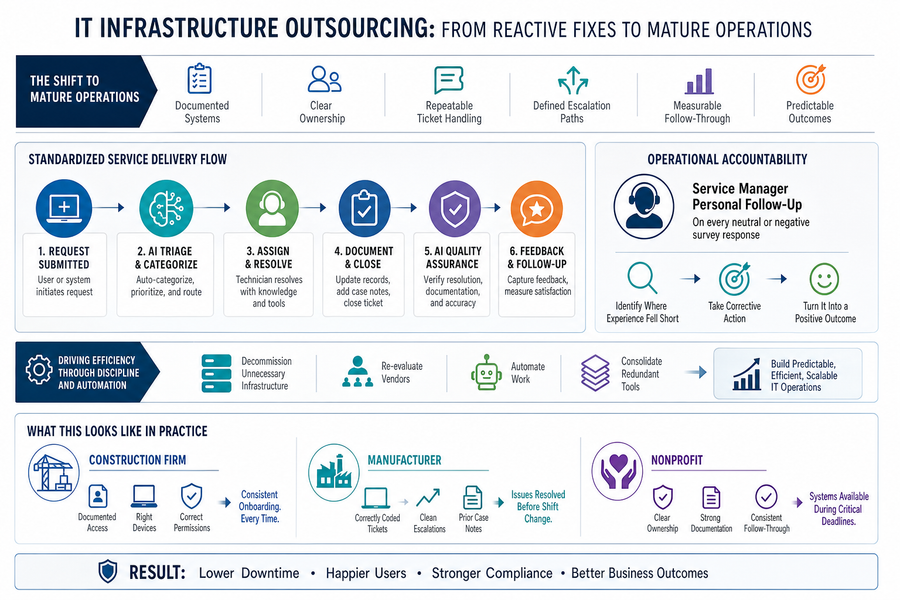
Mature IT operations depend on documented systems, defined escalation paths, repeatable ticket handling, and measurable follow-through. Without that discipline, the same workstation issue, Microsoft 365 problem, printer failure, or access request gets handled differently each time. IT infrastructure outsourcing should replace that variation with process control. We aligned our service delivery systems and processes to ITIL standards through a multi-year engagement because predictable operations require more than technical skill. That discipline matters as organizations pursue efficiency, including 34% adopting solutions that automate tasks. We use AI and automation to triage support cases quickly, so a ticket enters the queue with the right coding instead of waiting for manual sorting. After completion, we apply AI quality assurance to confirm the request was resolved and documented so the next technician can solve a similar issue faster. Accountability also has to extend beyond the ticket. When a neutral or negative survey response comes in, our Service Manager personally follows up to identify where the experience fell short and what needs to change. A closed ticket does not always mean the business impact was fully resolved. If an estimator lost half a day waiting for access, the process needs correction, not just closure.
Infrastructure Outsourcing Strengthens Cybersecurity And Insurance Readiness
Cybersecurity weaknesses now affect insurance renewals, audit preparation, privileged access reviews, phishing exposure, and after-hours response. Leadership needs controls that remain current as cyber liability requirements change. Our managed services are security-centric, not built from a confusing menu of optional protections, because most business leaders should not have to guess which safeguards belong in the baseline. Security remains a defined budget line, with 6% of overall 2025 IT budgets allocated to security solutions. A stronger outsourced model makes protections operational. Our cybersecurity stack includes 24x7 SOC monitoring, AI and machine learning phishing and malware prevention, DNS and content filtering, privileged access management, endpoint detection and response, vulnerability management, MFA, and security awareness training. Penetration testing may be included or sold separately depending on the service context. The goal is clear evidence for insurers, auditors, and executives when controls are reviewed.
| Insurance or Audit Request | Operational Evidence to Maintain | Typical Owner | Practical Readiness Benefit |
|---|---|---|---|
| Proof that privileged administrator access is controlled | PAM access logs, quarterly admin account review, break-glass account approval record | IT Director with CFO sign-off for financial system access | Reduces delays when underwriters ask how domain admin, Microsoft 365 global admin, and ERP superuser rights are governed |
| Evidence of endpoint protection coverage across all business devices | EDR deployment report showing laptops, servers, stale agents, and unmanaged devices | Managed Services Team and internal Operations Manager | Helps identify gaps before renewal questionnaires expose missing coverage on remote or recently onboarded endpoints |
| Confirmation that phishing controls and user training are active | Email security policy export, simulated phishing results, training completion report by department | Security Administrator with HR training coordinator | Supports clearer responses when carriers ask about mailbox protection, employee testing, and repeat-click remediation |
| Documented vulnerability remediation process | Monthly vulnerability scan results, patch exception register, ticket history for critical CVEs | Infrastructure Manager and application owners | Shows auditors that exposed systems, legacy applications, and deferred patches are tracked with accountable remediation dates |
| After-hours threat monitoring and escalation procedure | SOC alert history, escalation matrix, incident contact list, sample severity-based notification workflow | 24x7 SOC lead and client executive sponsor | Clarifies who is contacted for high-severity alerts outside business hours and how decisions are handed off to leadership |
Outsourcing IT Infrastructure In Ways That Protect Daily Workflows
Outsourcing IT infrastructure creates value when it protects the work employees repeat every day: opening tickets, joining calls, approving invoices, using Microsoft 365, and getting access without losing hours to follow-up. This matters as businesses balance cloud and dedicated systems, with 53% viewing dedicated servers as essential and 45% expecting dedicated server importance to grow by 2030.
- Support requests move faster: AI-assisted triage codes tickets quickly, while TimeZest lets users choose a service-call time that fits their schedule. That reduces phone tag and helps technicians connect when the user is available.
- Approvals avoid delays: Access requests, role changes, and onboarding move faster when ownership and documentation are current. As a Microsoft-first organization with Microsoft Modern Work certification, we focus on the productivity workflows employees use every day.
- Invoices become easier to forecast: Flat-rate pricing gives Accounting cleaner weekly, monthly, and annual planning. Leaders avoid surprise line items that blur normal operating costs, project work, hardware purchases, and future budget needs.
- Vendors have clearer accountability: Hardware purchasing, installation, configuration, and management need one coordinated process. We use vendor relationships to source, deploy, configure, and manage technology so clients are not left coordinating every handoff.
- Employees stay productive: Our 7 AM to 6 PM weekday support coverage aligns with when most requests occur, with urgent after-hours support as needed. For phone-dependent teams, our OneVoice hosted VoIP platform is owned and managed by us in two U.S. data centers, giving us direct control over the user experience and troubleshooting path.
IT Infrastructure And Outsourcing Decisions Leadership Should Make Before Signing
Changing the IT operating model affects systems, approvals, vendors, habits, and budgets already embedded in daily work. Leaders need structure before signing, especially when the decision touches security controls, hardware refreshes, cloud access, compliance preparation, and employee productivity. The stakes are measurable, with organizations reporting average infrastructure cost savings of $152,000 per year through disciplined infrastructure decisions. The right model may be fully outsourced IT, or it may be Hybrid IT, where an internal team keeps ownership of business-specific systems while outside specialists support cybersecurity, monitoring, upgrade projects, endpoint tools, and complex troubleshooting. Base the decision on workflow impact, risk exposure, internal capacity, and the level of accountability required.
- Map systems, owners, vendors, and renewal dates so leadership knows which tools support estimating, field reporting, patient records, donor systems, production scheduling, or client billing.
- Identify recurring support issues by department or location to separate isolated complaints from patterns affecting onboarding, field work, production, customer response, or month-end close.
- Review security controls tied to insurance and compliance including MFA, endpoint protection, vulnerability management, backup, HIPAA, NIST, FINRA, PCI DSS, SEC, GDPR, and ISO needs where relevant.
- Clarify internal versus outsourced ownership so internal staff can focus on business-specific applications while outside specialists manage infrastructure operations, security monitoring, vendor escalation, and complex technical issues.
- Require structured onboarding with an environment audit, vulnerability review, documentation, 111-Point Checklist, baseline report, and implementation sequencing. Our Discovery, Kickoff, Onboard, Baseline, and Onward process is designed to reduce disruption and establish priorities.
Build An IT Operating Model That Supports The Business
The benefits of IT infrastructure outsourcing are strongest when the operating model improves the work leaders already manage: tickets close with better documentation, new users receive the right access on schedule, security controls support insurance conversations, invoices are easier to forecast, and vendors have a defined path for resolution. GroupOne IT is a managed services firm in Sacramento, CA, serving construction, agriculture, manufacturing, health, nonprofit, and professional services organizations. We build managed IT around cybersecurity, predictable pricing, ITIL-aligned service delivery, and practical onboarding that starts with understanding the environment before making changes. If your organization is evaluating fully outsourced IT or Hybrid IT, contact GroupOne IT to review your systems, support patterns, security controls, and infrastructure priorities. We will help you define an operating model that keeps approvals, field teams, customer records, invoices, production systems, and cloud access moving without adding unnecessary complexity. Contact us today
|
Explore Managed IT Services Near You |
