







The myth is that choosing an IT model is a purchasing exercise. It is an ownership decision. When a construction file server fails during bid week, a manufacturer loses production drawings before a shift change, or a healthcare office faces cyber insurance renewal questions, the business does not need a menu of disconnected services.
It needs clear responsibility for the systems, tickets, approvals, records, and risk that keep work moving. The managed services vs. professional services decision matters because managed services already represent approximately 25-30% of the overall IT services market, yet market growth does not protect a business from gaps between vendors.
Sean Dugan, COO at GroupOne IT, notes: "IT service models are not interchangeable purchasing options. The wrong model creates ownership gaps, and those gaps show up in tickets, renewals, approvals, invoices, and risk."
Make Your IT Model Work With Clear Ownership Today
Opt for managed services so tickets, projects, security, and budgets follow clear ownership instead of confusion.
The better question is which model owns the outcome after the meeting, implementation, and invoice.
Managed Services vs. Professional Services as a Business Ownership Decision
The myth is that managed services and professional services are simply two pricing models. They are not. The real difference is ownership: who is responsible for day-to-day IT outcomes, and who is responsible for completing a defined scope of work.
Executives need this clarity before approving budgets, signing vendor contracts, or renewing cyber insurance because confusion creates exposure and cost noise. With 3 in 4 companies now expecting managed services to drive business model transformation and innovation, leaders should stop treating these decisions like technical add-ons.
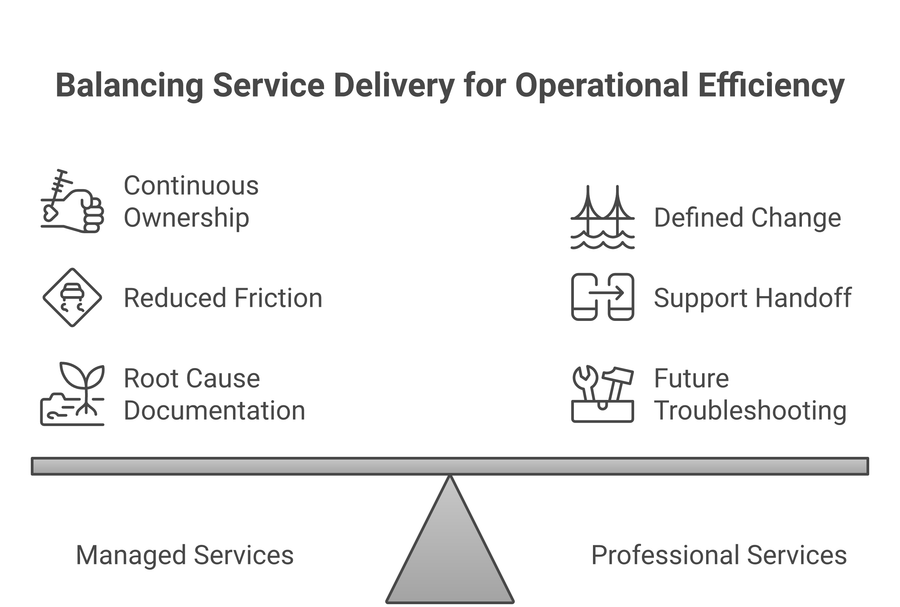
- Managed services own continuity. This covers helpdesk, patching, monitoring, endpoint protection, user support, vendor coordination, and ongoing cybersecurity controls, with predictable monthly fees Accounting can forecast.
- Professional services execute change. This fits migrations, network upgrades, VoIP implementations, security assessments, hardware refreshes, and cloud architecture projects.
- Confusion creates ownership gaps. A nonprofit cloud migration may be complete, while users, alerts, documentation, and insurance requirements continue after the project closes.
- Fit depends on maturity. The right model depends on internal IT capacity, compliance exposure, growth plans, and whether leadership needs recurring ownership, specialist execution, or both.
This is why we do not believe most businesses should be forced to choose from a long menu of security options they are not equipped to evaluate. Managed IT should define the controls the business needs, maintain them, document them, and adapt them as cyber liability insurance requirements change.
|
More About Managed Services |
Managed Services and Professional Services Show Up in Daily Operations
The distinction shows up inside daily workflows, not vendor proposals. A controller waiting on a workstation replacement, a plant supervisor unable to access production files, or a healthcare office enforcing MFA before a cyber insurance renewal does not care what the service category is called. They care who owns the next action. That pressure is why 89% of respondents believe effective managed services require a provider that can drive strategic outcomes rather than act like transactional outsourcing.
What this looks like in practice The controller needs approval, procurement, configuration, and installation handled without three disconnected tickets. The nonprofit needs seasonal staff onboarded with the right Microsoft 365 access, MFA, security awareness training, and documented offboarding dates. The plant supervisor needs access restored quickly, with the root cause documented so the same issue does not return.
Managed services keep ownership attached to tickets, alerts, users, devices, vendors, and security controls. Professional services move defined change forward, but mature delivery still needs triage, scheduling, documentation, and quality assurance so a completed project does not become recurring helpdesk noise.
Our service delivery systems are aligned to ITIL standards, and we use AI and automation to triage support cases, TimeZest to reduce phone tag, and AI quality assurance checks to review completed case documentation.
Managed Services or Professional Services Should Match Your Growth Capacity
The myth is that growth only requires more tools. In practice, growth requires capacity in the right places: support coverage, cybersecurity controls, project execution, and vendor coordination.
More users mean more endpoints, applications, approvals, invoices, and risk. The market is crowded, and by the end of 2025, roughly 341,000 channel partners will offer managed services, so leaders need to look past labels and evaluate operational accountability.
A manufacturer adding a second shift may need endpoint management, after-hours alert response, network troubleshooting, and a planned firewall replacement. A construction firm opening a new office may need procurement, device imaging, Microsoft 365 setup, VoIP deployment, and secure project-file access before the first project manager arrives. Hiring every specialty skillset full time is rarely practical. We use Hybrid IT to augment internal IT with cybersecurity, monitoring, upgrade projects, endpoint management tools, and complex troubleshooting while internal staff keep control of the business context.
Professional services still matter for defined work like cloud migration, penetration testing, VoIP deployment, or network redesign. The deciding factor is whether the work ends cleanly, or whether users, alerts, vendors, documentation, and security requirements need ongoing ownership afterward.
Managed Services and Professional Services Create Costs When Ownership Is Unclear
Executives see the consequences in delayed tickets, stalled approvals, repeat invoices, missed renewal requirements, and unclear accountability. With project-based IT work such as infrastructure upgrades typically costing $1,000-$10,000+ depending on scope and complexity, unclear ownership turns a planned investment into recurring operational drag.
- Support issues stay unowned. Tickets bounce between project vendors, internal staff, and helpdesk resources when no one owns the daily operating outcome.
- Security controls lose momentum. MFA, endpoint detection, DNS filtering, vulnerability management, privileged access management, SOC response, phishing prevention, and security awareness training require ongoing ownership after setup.
- Budgets become hard to forecast. Emergency support, hardware needs, cloud costs, and recurring fees become difficult for Accounting to plan when teams handle everything as a one-off.
- Documentation handoff breaks down. Thin project notes force future technicians to rediscover permissions, vendors, licensing, and configuration decisions.
- Users absorb the drag. Recurring access issues, device problems, phone interruptions, and vendor delays pull employees away from production schedules, patient service, donor operations, or client deadlines.
|
Decision Area |
Operational Question to Resolve |
Accountable Role or Owner |
Concrete Evidence to Maintain |
|
Cybersecurity control ownership |
Who verifies that MFA, endpoint detection and response, DNS filtering, vulnerability scans, and security awareness training remain active after deployment? |
Managed Services Security Lead with approval from the COO or Compliance Officer |
Monthly control status report, SOC alert summaries, MFA enrollment export, phishing simulation results, vulnerability remediation log |
|
Project-to-operations handoff |
What must be delivered before an infrastructure upgrade, cloud migration, or phone system rollout is accepted as complete? |
Project Manager handing off to Helpdesk Manager |
Admin credentials escrow record, network diagram, vendor support contacts, licensing inventory, rollback notes, configuration screenshots |
|
Budget classification |
Which expenses are recurring service commitments, which are approved projects, and which require emergency authorization? |
Controller working with IT Service Owner |
Monthly services schedule, project statement of work, hardware refresh forecast, cloud usage report, emergency change approval record |
|
Renewal and compliance readiness |
Who tracks cyber liability insurance requirements, software renewals, certificate expirations, and vendor contract dates? |
IT Account Manager with Finance and Risk Management review |
Renewal calendar, insurance questionnaire responses, license expiration report, vendor contract repository, evidence of EDR and SOC coverage |
|
User-impact escalation |
When do recurring access failures, device replacements, or phone outages move from helpdesk handling to management review? |
Service Desk Manager escalating to Department Manager |
Ticket trend report by user group, SLA breach log, repeat-incident analysis, affected revenue or service queue notes |
Managed Services From Professional Services to a Practical Plan
Leadership has approved growth, a renewal or audit is approaching, internal IT is stretched, and several technology projects are waiting. This is the moment to separate recurring ownership from defined execution before tickets, vendors, invoices, and security requirements compete for the same overloaded people.
Changing IT ownership affects users, vendors, budgets, approvals, and internal habits. A structured onboarding process turns that complexity into a working plan through an environment audit, systems vulnerabilities review, compliance review, 111-Point Checklist, baseline report, and strategic recommendations. That discipline matters because in 2024, only 34% of organizations completed projects on or ahead of schedule.
Start with three questions: who owns daily support after the project closes, who maintains the security controls your insurer expects, and which initiatives need specialist execution rather than permanent headcount. At GroupOne IT, we use that lens to help partner-clients decide where managed services, professional services, and Hybrid IT fit, then build the operating plan around real workflows, budgets, and deadlines. If your file server, production access, cyber insurance renewal, or project backlog already has multiple owners on paper and no clear owner in practice, start there. Contact us today.
Explore Managed IT Services Near You
