







The myth is that the next hire fixes the IT problem. Not when a file server stalls during bid week, a healthcare workstation misses a patch, or Accounting cannot close invoices because a cloud login issue is buried behind twelve older tickets.
The choice between staff augmentation vs. managed services is an accountability decision, not a headcount debate, especially when 83% of executives cite workforce limitations as a barrier to secure operations. As a Sacramento-based Managed Services Firm, we work with SMBs across Construction, Agriculture, Manufacturing, Healthcare, Nonprofit, and Professional Services, where systems, approvals, vendors, cyber liability requirements, and user productivity have to move together.
Our COO, Sean Dugan, notes: "Choose the IT model based on who owns the outcome, who documents the control, and who keeps service delivery moving when users, vendors, and security requirements collide."
Choose the Right IT Model With Clear Ownership Today
Choose managed services so tickets, security, vendors, and budgets have clear ownership and fewer delays.
Staff Augmentation vs. Managed Services for Operational Control
More hands do not automatically create more control. Staff augmentation adds people to the operating model you already run. Managed services assign defined responsibility for support, monitoring, patching, cybersecurity controls, backups, vendor coordination, and reporting cadence.
That distinction matters when unresolved tickets affect production, invoicing, and approvals. If a contractor is waiting for internal direction, your IT lead still owns prioritization, escalation, and results. Staff augmentation fits defined overflow, specialist expertise, or project-based support. It does not replace operating discipline.
- Accountability changes hands: Staff augmentation fits when internal leadership still owns decisions and results. Managed IT fits when the business needs outside ownership for recurring helpdesk, monitoring, patching, backups, cybersecurity controls, vendor coordination, and follow-through.
- Tickets need ownership: Adding a contractor does not repair weak intake, unclear escalation, or missing documentation, and four out of five businesses report difficulty recruiting needed talent. If no one owns the queue, aging tickets still age.
- Cybersecurity controls require cadence: Security work fails when it becomes a side task. Our managed services approach standardizes the core protections each partner-client should have, aligned to cyber liability insurance requirements, rather than asking leaders to choose from a technical menu.
- Costs need forecasting: Temporary labor often follows hours and scope changes. Flat-rate managed services give Accounting cleaner monthly expectations because coverage and recurring responsibility are defined.
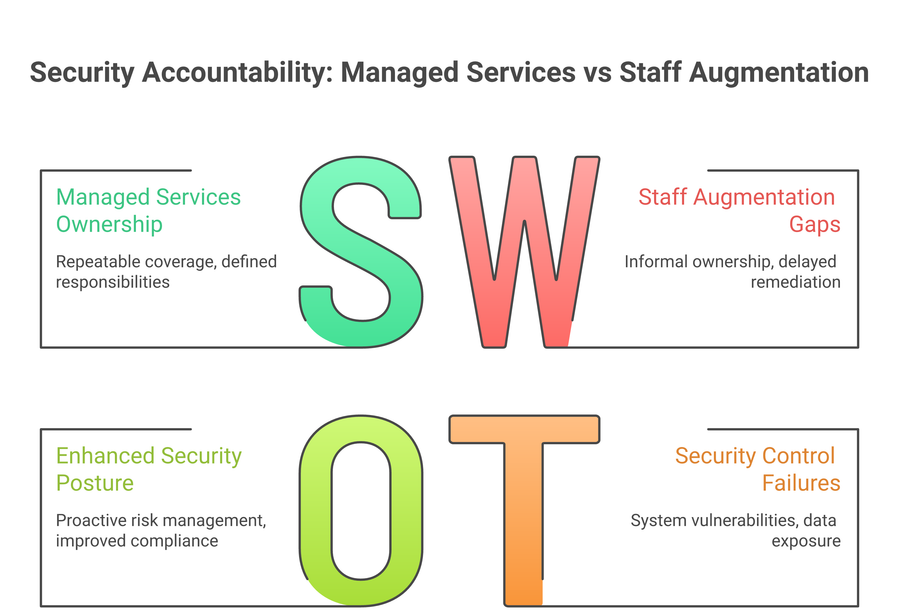
Managed Services Vs Staff Augmentation in Security Accountability
Security accountability breaks down when everyone assumes someone else checked the control. In managed services vs staff augmentation, the practical question is who owns the security outcome when MFA is incomplete, a laptop is unmanaged, or an insurance questionnaire asks for evidence the team cannot produce quickly.
Augmented support brings valuable skills, but security operations need repeatable coverage across endpoint detection and response, vulnerability management, phishing and malware prevention, content and DNS filtering, privileged access management, SOC escalation, MFA, and security awareness training. The labor market makes informal ownership risky, with two in three organizations facing moderate-to-critical skills shortages.
Real-world snapshot A construction firm's internal IT manager handles jobsite connectivity, vendor calls, endpoint refreshes, and cyber insurance evidence. Three unmanaged laptops appear in a vulnerability report. Project managers wait on approvals, Accounting waits on vendor answers, and leadership waits for risk clarity.
In our model, the work is assigned, documented, validated, and reported back through a defined service process, supported by a cybersecurity stack that includes 24x7 SOC coverage, AI/ML phishing and malware prevention, content and DNS filtering, privileged access management, endpoint detection and response, vulnerability management, MFA, and security awareness training.
Comparing Staff Augmentation And Managed Services Through Workflow Maturity
The day-to-day difference shows up in how work enters IT, how it moves, and how it closes. A mature workflow cannot depend on one overwhelmed manager remembering every approval, vendor dependency, and user follow-up, especially when 70% expect demand for technical contributors to rise.
When comparing staff augmentation and managed services, look at the support record, not the org chart. The right model should improve triage, documentation, endpoint visibility, and escalation ownership.
- Ticket intake becomes measurable. Work has to be categorized correctly before it can be resolved efficiently. We use AI and automation to triage support cases so tickets enter the queue with clearer coding and less manual dispatch delay.
- Scheduling reduces user friction. Random callbacks create phone tag for supervisors, clinicians, project managers, and accounting staff. We use TimeZest so partner-client users can choose a service-call time that fits their schedule, supporting a cleaner support experience and better first-call closure.
- Documentation protects continuity. A closed ticket without useful notes becomes tomorrow's repeated issue. After case completion, we use AI-supported quality assurance checks to help confirm the request was satisfied and documented.
- Escalations follow clear ownership. Our ITIL-aligned service delivery processes define when work moves from Tier 1 to Tier 2 or Tier 3, who follows up with vendors, and when leadership needs visibility. Service discipline determines whether users get timely answers and whether leadership can trust the support process.
- Quality checks improve resolution. Closure should mean the issue was addressed, the user was informed, and the notes are complete. Our Service Manager personally investigates neutral or negative survey feedback to understand where the partner-client experience fell short and what needs to improve.
More About Managed Services
- How to Choose a Managed Services Provider: Cut Through the Noise!
- Comparing Break-Fix vs. Managed IT Services - GroupOne IT
- What Are Managed IT Services? A Deep Dive Into The Modern IT Engine Your Business Runs On
Choosing Between Managed Services and Staff Augmentation for Cost Predictability
CFOs do not need another invoice category that is hard to forecast and harder to explain. Staff augmentation usually ties cost to people, hours, projects, or temporary capacity. Managed services tie operating cost to defined coverage, support scope, standards, and recurring responsibility.
This matters because 60% turning to contract professionals to meet skills needs still have to answer a basic Accounting question: what will IT cost next month, and what does that spend cover?
Start with the work itself.
- Map recurring support demand by category, including password resets, endpoint issues, cloud access, printer tickets, and line-of-business application problems.
- Separate project work from daily operational work.
- Identify insurance or compliance controls before deciding who owns implementation, evidence, and follow-through.
- Review invoice patterns and surprise charges so Accounting can compare variable labor against flat-rate pricing and clear agreements.
- Decide who owns vendor follow-through, including sourcing, ordering, installing, configuring, and managing equipment.
We emphasize predictable monthly fees because forecasting is how leaders approve spend with fewer surprises and how Accounting codes expenses without repeated clarification.
|
Evaluation Area |
What Finance Should Test |
Operational Example |
Decision Signal |
|
Ticket volume stability |
Compare 6-12 months of help desk tickets by category, location, and severity. |
Microsoft 365 password resets, laptop imaging, printer issues, and VPN access requests recur weekly. |
High repeat volume favors managed services with predictable monthly fees. |
|
Project variability |
Identify work with a defined start date, end date, and deliverable owner. |
A 90-day ERP integration needs a contract SQL developer and milestone reporting. |
Temporary specialist demand favors staff augmentation when the work is not ongoing operations. |
|
Compliance ownership |
Confirm who documents controls, tracks remediation, and stores evidence. |
Cyber insurance requires MFA enforcement, endpoint reports, backup test records, and admin access reviews. |
Recurring service ownership reduces control gaps after implementation. |
|
Vendor and equipment lifecycle |
Review who handles quotes, approvals, installation, configuration, warranties, and replacement planning. |
We can source Dell laptops, order firewall hardware, install devices, configure policies, and help manage renewals. |
Centralized vendor follow-through reduces unplanned coordination costs. |
|
Invoice explainability |
Check whether Accounting can tie charges to an agreement, service level, or budget owner. |
Hourly contractor invoices require IT director review before coding. |
Flat-rate agreements help Accounting forecast expenses and reduce month-end clarification work. |
Evaluate Staff Augmentation Or Managed Services Before You Decide
If your internal team is buried in tickets, renewals, endpoint work, cloud administration, vendor calls, and security controls, the question is not simply whether you need more help. The better question is what kind of accountability the business needs next, especially when nearly a quarter, 23% of cybersecurity professionals report being laid off within the past year.
Use a practical decision screen before choosing staff augmentation or managed services.
- Choose staff augmentation when you have a strong internal IT leader, clear priorities, documented procedures, and a defined project or overflow need.
- Choose managed services when recurring support, cybersecurity controls, monitoring, patching, backups, vendor coordination, and reporting need outside ownership.
- Consider a hybrid IT model when your internal team needs specialist depth for networking, cybersecurity, endpoint management, or complex troubleshooting without adding full-time roles.
For Sacramento-area SMBs, GroupOne IT starts with discovery, an onsite audit, a vulnerability and systems review, and a baseline report. That gives leadership a clearer view of what must be staffed internally, what should be managed externally, and which operational risks deserve attention first. Contact us today.
Explore Managed IT Services Near You
